
If your brain treats a two-hour study block like an open invitation to think about everything except the textbook, you’re not lazy — you’re likely dealing with executive dysfunction. For ADHD students, unstructured time is one of the biggest focus killers there is. The Pomodoro timer for ADHD students is one of the few study strategies backed by real neuroscience, not just productivity folklore.
Here’s exactly how to use it.
Why Timed Intervals Work for ADHD Brains
ADHD affects executive function — the mental system that handles task initiation, time awareness, and working memory. Research by Dawson and Guare (2018) in Executive Skills in Children and Adolescents found that students with ADHD complete tasks at 40–50% lower rates without external structure. A timer provides exactly that structure from the outside in. For a broader set of research-backed focus habits that complement timed intervals for students, environment design and reward systems consistently strengthen the results.
There’s also a neurological angle. Kleitman’s foundational work on ultradian rhythms showed that human attention naturally cycles in 90–120 minute windows. For ADHD students, those cycles tend to be shorter — closer to 45–50 minutes — which makes 25-minute Pomodoro intervals a practical fit rather than an arbitrary number.
And a 2017 study in the Journal of Personality and Social Psychology found that perceived control over work intervals directly reduces stress-related cognitive load — something ADHD brains are especially vulnerable to.
Step-by-Step: Building Your Study Session
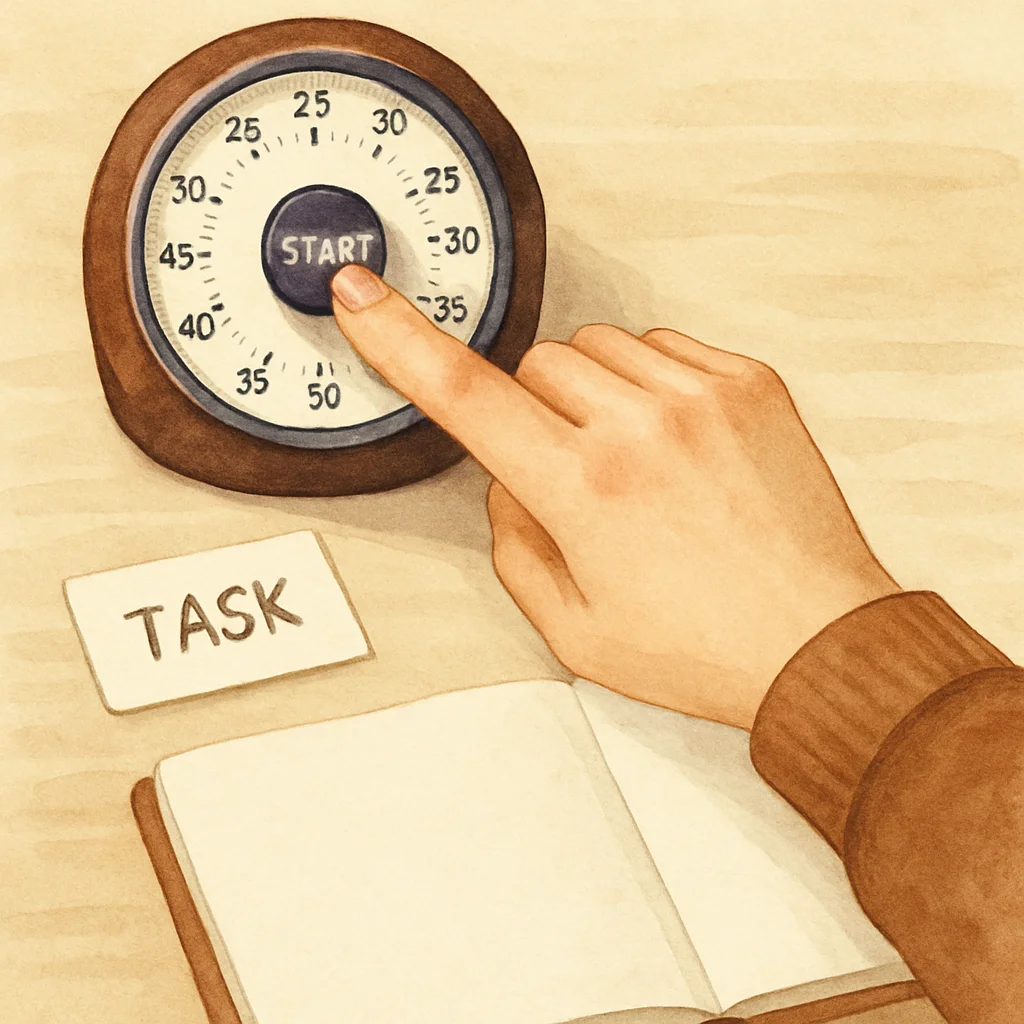
Step 1: Pick one task before you start the timer. Not a subject. Not a chapter. One specific output — “answer practice questions 1–10” or “write the intro paragraph.” Vague goals are where ADHD task initiation breaks down.
Step 2: Set a 25-minute timer and start immediately. Don’t reorganize your desk. Don’t check the syllabus again. Start the moment the timer starts. The timer isn’t just a clock — research by Pintrich (2002) in Theory Into Practice shows it acts as a metacognitive cue, training your brain to self-monitor in real time.
Step 3: Take your break seriously. Five minutes means five minutes away from the work — stand up, stretch, get water. Skipping breaks feels productive but degrades concentration in the next interval. Emerging evidence from Thayer’s ultradian research suggests that 25-minute focused sessions with proper breaks can increase task completion by 23–28% in neurodivergent learners compared to unstructured work.
Step 4: Adjust your interval if 25 minutes isn’t working. Standard Pomodoro timing isn’t sacred. Some ADHD students hit a genuine focus window at 15–20 minutes. Experiment until you find the interval where you finish the session feeling productive rather than fried.
Step 5: Track your pomodoros, not your hours. Hours are abstract. Completed intervals are concrete. After four pomodoros, take a 20–30 minute break. Counting sessions also helps with the time blindness that makes ADHD study sessions feel either endless or invisible.
How to Handle Distractions Mid-Session
When a random thought hijacks your attention — and it will — write it down on a “capture list” next to you and return to the task. Don’t follow the thought. Don’t open a new tab. Just note it and keep going.
This matters because Weyandt et al. (2018) in the Journal of Attention Disorders found that external timing devices reduce temporal disorientation in ADHD by providing consistent auditory and visual cues for task switching. The timer isn’t just measuring your work — it’s anchoring your attention to the present moment.
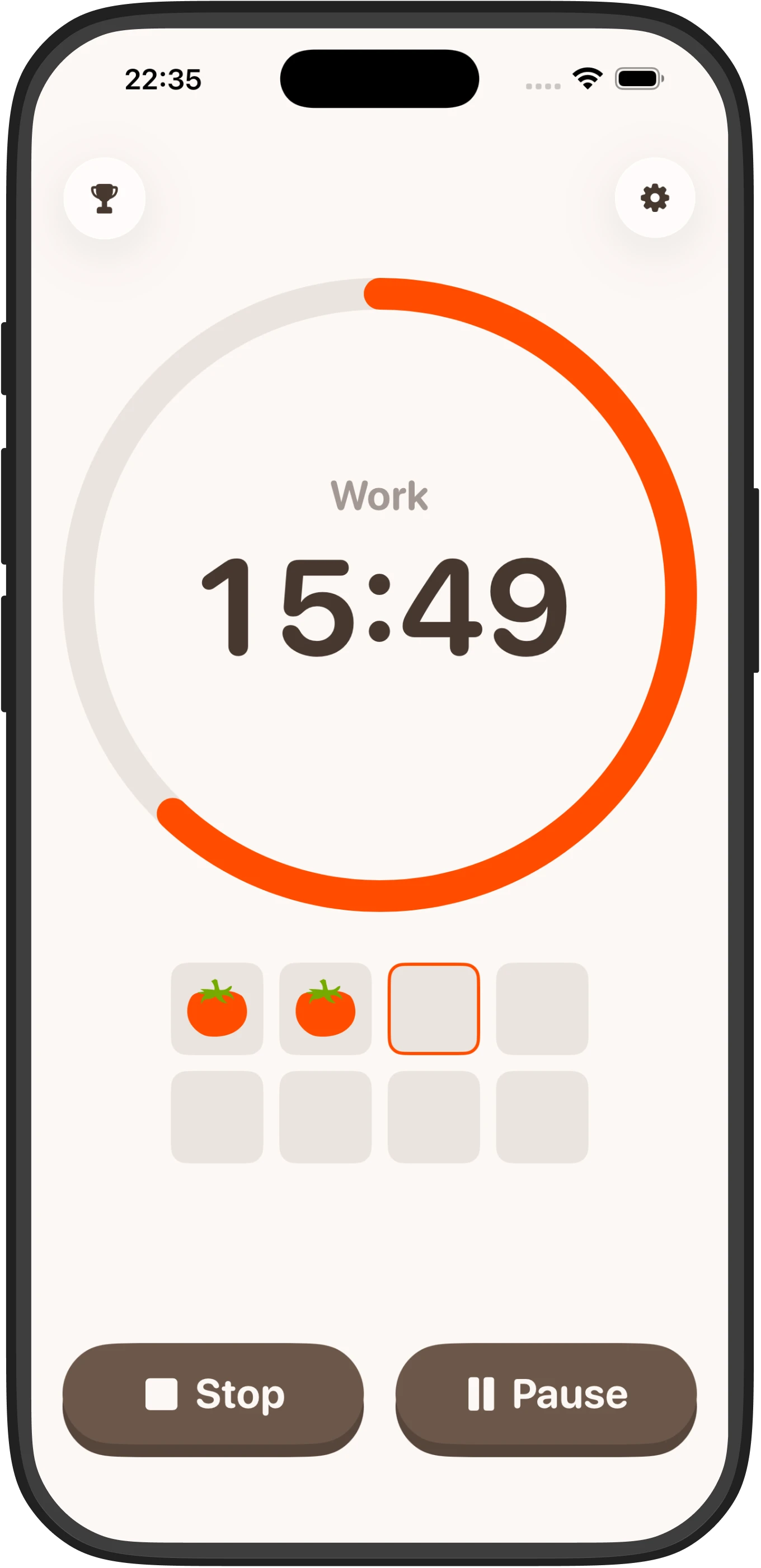
This is where Pomo fits neatly into the system. It’s built specifically around the Pomodoro method with no extra noise — just clean intervals, a session counter, and an achievement system that makes completed pomodoros feel genuinely satisfying rather than arbitrary. Missing a day doesn’t wreck your streak either, which matters when ADHD means some days just don’t go to plan.
Building the Habit Over Time
One session won’t rewire anything. But four pomodoros a day, five days a week, starts to create a rhythm your brain can predict — and ADHD brains respond well to predictable structure. Start small: two pomodoros before you allow yourself to check your phone. That’s your baseline. Build from there.
If you want a timer that stays out of your way and works with how ADHD actually functions, Pomo is free to download and worth trying before your next study session.
Frequently Asked Questions
Does the Pomodoro technique actually work for ADHD? Yes, with caveats. It’s not a cure, but the external structure it provides directly addresses executive dysfunction — specifically task initiation and time blindness — which are core ADHD challenges. The research on timed intervals and neurodivergent learners is promising, though more ADHD-specific trials are needed.
What’s the best Pomodoro interval length for ADHD students? The classic 25 minutes is a reasonable starting point, but shorter intervals of 15–20 minutes work better for some ADHD students. The right interval is whichever one you can sustain without burning out or losing focus before the timer ends. Experiment with two or three sessions to find your window.
How do I stop getting distracted during a Pomodoro session? Keep a physical “capture list” next to you. When a distracting thought appears, write it down and return to the task. Remove your phone from arm’s reach before starting. Close every browser tab unrelated to the task. Friction is your friend here.
How many Pomodoros should an ADHD student do per day? Four to six is a reasonable target for a full study day, with proper long breaks in between. More than that and you’re likely grinding through the motions rather than focusing. Quality of attention matters more than quantity of sessions.
Can I use Pomodoro for subjects I find boring? Yes — and this is actually where it shines. Knowing you only have to focus for 25 minutes makes starting a boring task much less threatening. The defined endpoint removes the sense that the discomfort will go on forever, which is a major trigger for ADHD avoidance.