

You’re sitting down to work at 2pm. You think maybe 20 minutes pass. You look up. It’s 4:47pm.
Or the opposite: you’re convinced you’ve been studying for an hour. It’s been eleven minutes.
This isn’t carelessness. It’s not a personality flaw. Russell Barkley — one of the world’s leading ADHD researchers — has spent decades making the case that what you’re experiencing is a core neurological deficit, not a character one. He calls it time blindness, and it changes everything about how ADHD brains move through the world.
What Barkley Actually Said
Barkley’s executive function model, laid out across decades of research and summarized in his work on ADHD, reframes ADHD entirely. The real problem isn’t attention — it’s the inability to regulate behavior across time.
Neurotypical brains have what he calls a sense of time that stretches forward and backward. You feel the weight of a deadline approaching. You remember how long something took last week and calibrate accordingly. That internal clock runs quietly in the background, pulling past experience and future consequence into the present moment.
ADHD brains don’t work that way.
According to Barkley, ADHD creates a binary relationship with time. There’s now — whatever is immediately in front of you — and not now, which is everything else. Deadlines, appointments, promises, long-term goals: unless they’re happening this second, they exist in an undifferentiated blur. The future doesn’t feel real until it’s almost the present.
This isn’t metaphorical. It has a neurobiological substrate.
What’s Actually Happening in the Brain
Research on time perception in ADHD has identified neurobiological differences. Studies using neuroimaging have shown that ADHD is associated with differences in prefrontal regions — including the anterior insula and dorsolateral prefrontal cortex — areas involved in time estimation and temporal processing. Additionally, dysregulation in the anterior cingulate cortex and basal ganglia, circuits that handle time representation and working memory, has been implicated in time blindness. When those circuits function atypically, your sense of duration can be affected. You’re not bad at estimating time because you don’t try. You may experience difficulty with it because the neural systems involved in time perception operate differently.
Research indicates that many adults with ADHD report difficulty estimating how much time has passed. ADHD individuals have also been found in some studies to systematically perceive time intervals differently than neurotypical controls — a consistent pattern rather than random error.
The Temporal Discounting Problem
Here’s where time blindness gets especially costly in daily life.
Research on temporal discounting — the tendency to prefer a smaller immediate reward over a larger delayed one — has found differences in ADHD populations compared to controls. Individuals with ADHD show steeper discounting of future rewards.
What this means practically: when the future feels unreal, anything that pays off later loses value fast. Studying now so the exam goes well in three weeks? The exam doesn’t feel real. Finishing the project today so Friday feels relaxed? Friday is in “not now.” The brain keeps routing back to what’s immediately gratifying because that’s the only time that feels tangible.
This is also why so many ADHD strategies that rely on future-oriented motivation — “just think about how good you’ll feel when it’s done” — often fail. The emotional reality of that future moment isn’t accessible.
Why “Just Try Harder” Misses the Point
This research matters because it shifts the frame entirely.
If time blindness were about effort or discipline, then more willpower would fix it. But you can’t willpower your way into having different neural function. You can’t motivate yourself into different prefrontal timing circuitry. Barkley has argued that ADHD is not a deficit of knowledge or ability, it’s a deficit of performance — specifically, performing what you know across time.
That’s a different problem that needs different solutions. And the solution Barkley and others consistently point to isn’t internal. It’s external.
External Timers as Neurological Scaffolding
If the internal clock functions atypically, you build an external one.
This isn’t a workaround or a crutch — it’s exactly what the research recommends. External cueing and visual timers have been found in research to improve task completion for many adults with ADHD. The mechanism: externalizing time perception provides external reference points that can compensate for difficulties with internal time perception. You’re not repairing the broken clock. You’re using tools that work with how your brain actually functions.
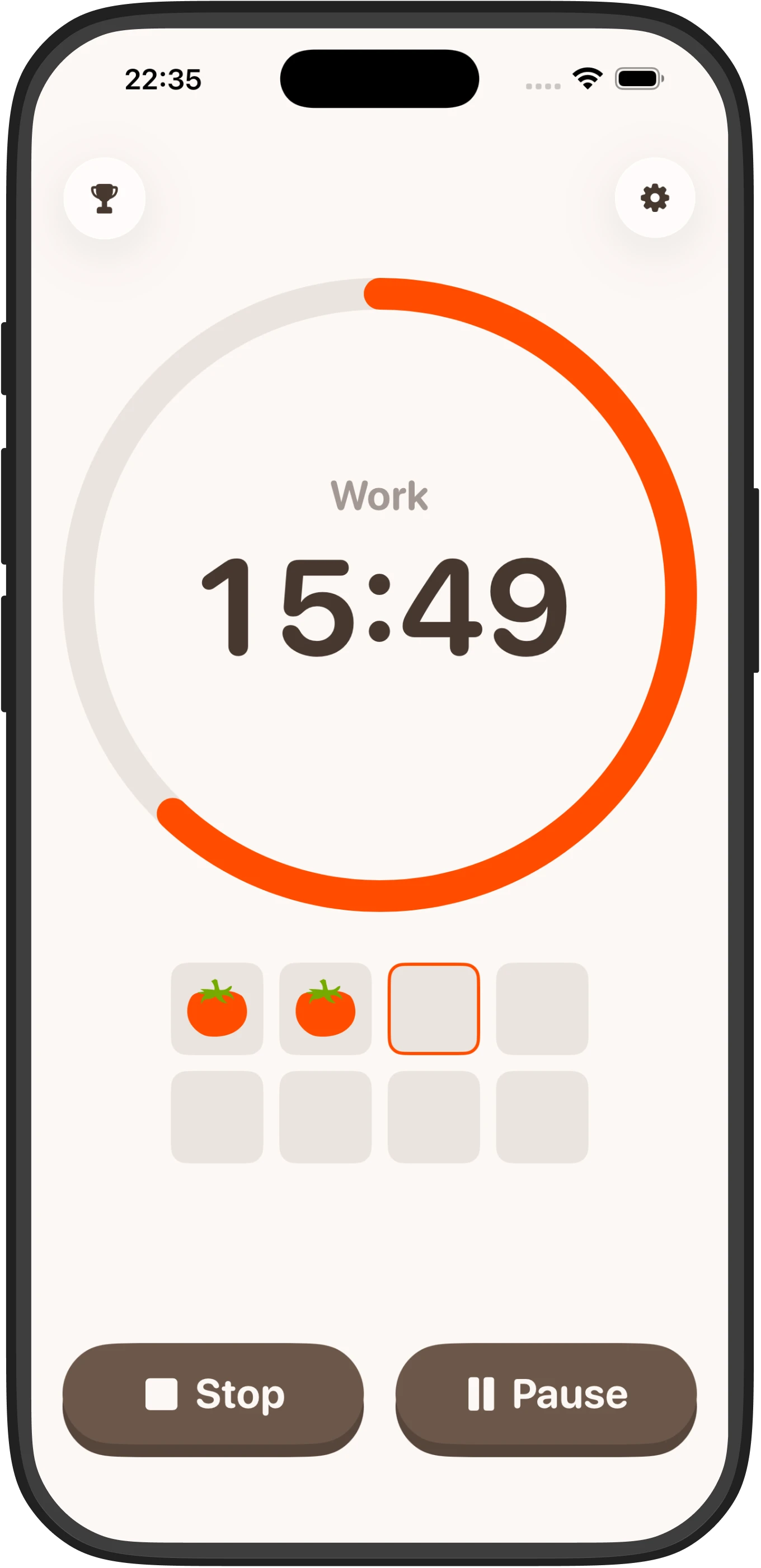
This is exactly why the Pomodoro Technique resonates so strongly with ADHD brains — the timer isn’t just a productivity trick, it provides an external representation of time. The ticking down, the visual elements, the end alarm: these aren’t motivational gimmicks. They’re sensory inputs that can help compensate for difficulties with internal time perception.
For people who also deal with the task-initiation side of this, there’s a useful overlap with the more general challenge of starting tasks with ADHD — time blindness is often connected to difficulties with task initiation.
What Actually Helps: Practical Takeaways
Understanding the neuroscience is useful, but you need tools that work day to day. Here’s what research and clinical practice point toward:
Make time visible, not just audible. Visual timers — ones that show time depleting as a graphic, not just a number — can work well for many people with ADHD. The visual representation keeps time in your sensory field.
Use intervals, not open-ended blocks. “Work until lunch” lacks clear temporal boundaries. A 25-minute timer provides a defined interval. Short, bounded intervals make time more concrete in a way that open-ended sessions don’t.
Externalize transitions. The shift between tasks is where time perception difficulties often cause the most disruption — you finish one thing and time passes without you starting the next. Alarms, calendar notifications, and physical cues between tasks can help.
Build in buffer time structurally. If you think something will take 30 minutes, schedule 50. This isn’t pessimism — it’s calibration based on how you actually experience duration.
Pair tasks with time. Because time can feel abstract with ADHD, tasks without a time anchor feel free-floating. Attaching a task to a specific time (“I’ll write this section from 10:15 to 10:40”) gives it temporal definition.
FAQ
What is ADHD time blindness?
ADHD time blindness is a neurobiological difficulty perceiving the passage of time, where the brain experiences a binary relationship with time—“now” (the immediate moment) and “not now” (everything else). This means deadlines, appointments, and future consequences don’t feel real until they’re almost happening, creating the sensation that hours have passed in minutes or vice versa.
Is time blindness a real neurological condition?
Yes. Research shows ADHD is associated with differences in prefrontal regions including the anterior insula, dorsolateral prefrontal cortex, and dysregulation in the basal ganglia—all involved in time perception and temporal processing. This isn’t a character flaw or lack of effort; it’s a measurable neurobiological difference in how the brain estimates duration.
Why does “just try harder” not work for time blindness?
Time blindness is a deficit of neural performance, not willpower or knowledge. You cannot motivate yourself into having different prefrontal timing circuitry. Since the internal clock functions atypically, willpower alone cannot compensate—you need external tools and scaffolding instead.
What external tools actually help with time blindness?
Visual timers, calendar alerts, structured intervals (like the Pomodoro Technique), and time-specific task anchors are most effective. These work because they externalize time perception and provide sensory reference points that compensate for internal time perception difficulties, keeping time tangible and present in your awareness.
Does time blindness affect decision-making in ADHD?
Yes. Research on temporal discounting shows people with ADHD heavily prefer immediate rewards over delayed ones because the future doesn’t feel real. This makes motivation based on future outcomes—like studying now for an exam in three weeks—ineffective, since that future consequence lacks emotional and temporal reality.