
The pomodoro technique for ADHD isn’t just another productivity hack repackaged for neurodivergent brains. It actually addresses three specific neurological deficits that make focus so hard: broken time perception, attention regulation struggles, and a reward system that runs on fumes.
Here’s why it works and how to start today.
Time Blindness: Your Internal Clock Is Unreliable
Up to 80% of people with ADHD show measurable deficits in time perception (Toplak et al., 2006). You know the feeling — you sit down “for a minute” and suddenly two hours vanished. Or a 30-minute task feels like it’ll take five hours, so you don’t start at all.
The Pomodoro Technique replaces your unreliable internal clock with an external one. Set a 25-minute timer, work on one thing, stop when it rings. That’s it. A 2019 study from Kofler et al. found that external cues like structured start/stop signals significantly improved working memory performance in ADHD participants compared to unstructured conditions.
You don’t need to feel how long 25 minutes is. The timer knows.
Attention Resets: Breaks Aren’t Laziness
ADHD doesn’t just mean distraction — it also means hyperfocus, where you lock onto one thing for hours while everything else burns. Both states — scattered attention and maladaptive hyperfocus — get worse without structured breaks (Hupfeld, Abagis & Shah, 2019). Structured breaks are also a cornerstone of the environment and habit design strategies that help students sustain attention.
A 2011 study in Cognition by Ariga & Lleras found that brief diversions from a task eliminated the vigilance decrement — the natural decay in attention quality over time. The 5-minute Pomodoro break isn’t wasted time. It’s the reset that makes the next sprint possible.
Dopamine Micro-Rewards: Completing Sprints Feels Good
Here’s the part most guides skip. NIH-led PET imaging research by Volkow et al. (2009) showed that ADHD adults have lower dopamine receptor availability in reward pathways. Translation: your brain needs more frequent wins to stay motivated.
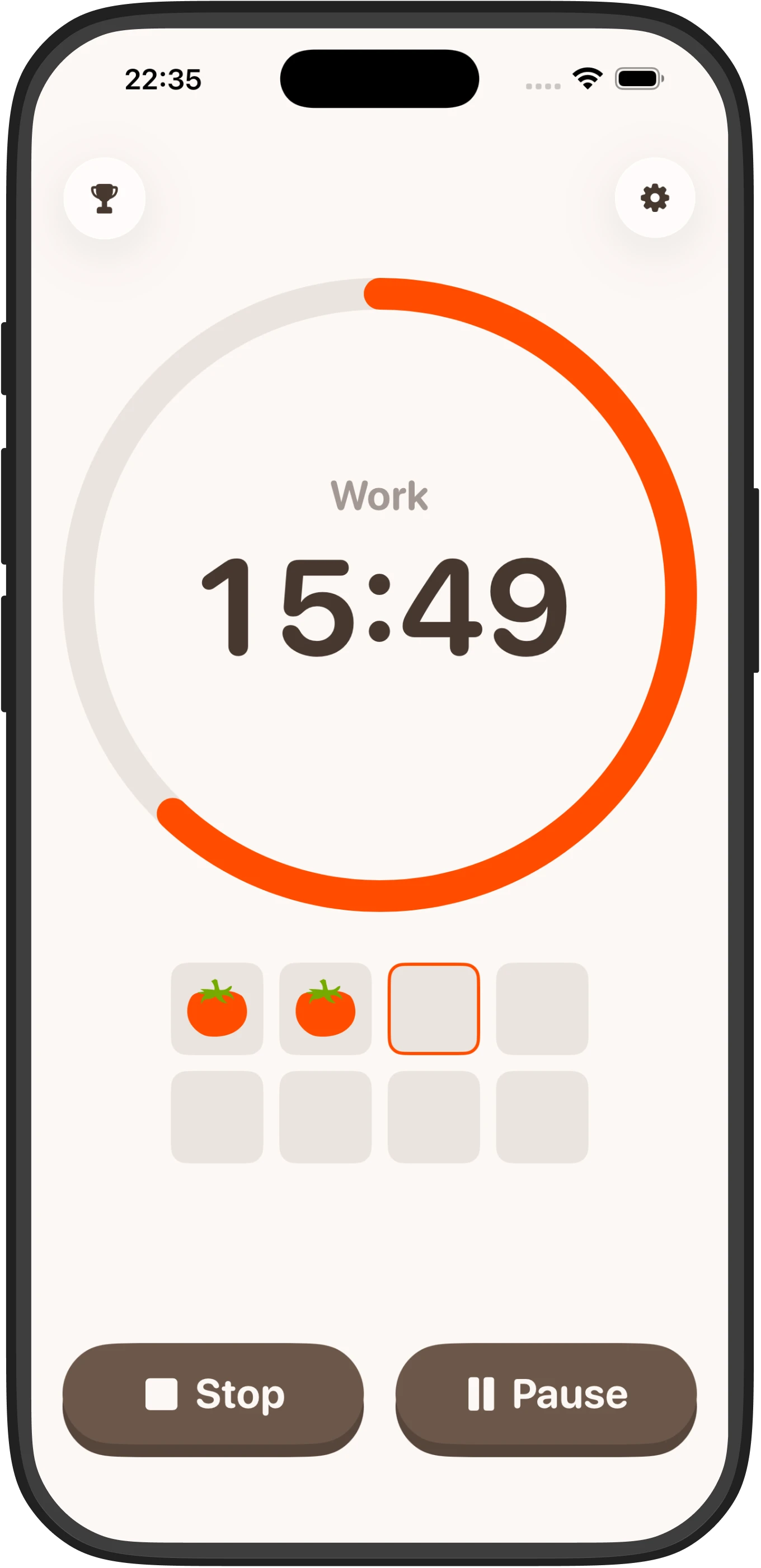
Each completed Pomodoro is a small, concrete win. You didn’t just “work for a while” — you finished a defined sprint. That micro-reward loop partially compensates for blunted dopamine signaling, which is why Pomo tracks your completed sessions and streaks: visible proof of progress gives your reward system something tangible to latch onto.
How to Start: The ADHD-Friendly Setup
- Pick one task. Not a to-do list. One thing.
- Set a timer for 25 minutes (shorter is fine — 15 minutes works too)
- Work until the timer stops. Not until you “feel done.”
- Take a 5-minute break. Stand up, move, don’t scroll social media.
- After 4 sprints, take a 15–30 minute break.
If 25 minutes feels impossible, start with 15. The specific number matters less than the structure. Adults with ADHD are 2–3× more likely to struggle with time management than neurotypical peers (Barkley et al., 2008), so any external scaffold is better than relying on willpower alone.
FAQ
Does the Pomodoro Technique actually help with ADHD?
Yes — it directly compensates for time blindness, attention regulation deficits, and low dopamine reward signaling, three clinically documented ADHD challenges.
How long should ADHD work intervals be?
Start with 15–25 minutes. There’s no universal “best” length. The goal is short enough to feel approachable, long enough to get something done.
What is time blindness in ADHD?
It’s the clinically observed difficulty in estimating, tracking, and reproducing time intervals. Harvard Health describes it as a core executive function deficit in ADHD.
What’s the best productivity method for ADHD?
No single method works for everyone, but timed-interval systems like Pomodoro have the strongest alignment with ADHD neuroscience because they externalize time, force breaks, and create frequent rewards.
Can I modify the Pomodoro Technique for ADHD?
Absolutely. Shorter sprints, longer breaks, skipping the rigid 4-cycle structure — all valid. Any timer that lets you customize intervals and doesn’t punish missed days is worth trying.