

You know exactly what you need to do. You’ve known for hours. The tab is open. The document is right there. And yet — nothing. You’re refreshing the same three apps, waiting for something to shift, some internal switch to flip that finally makes starting feel possible.
This is the daily experience of ADHD procrastination. And if you’ve spent years being told it’s a character flaw — laziness, immaturity, not caring enough — there’s something important you should know: brain imaging research has shown it involves neurobiological differences rather than willpower alone.
What Volkow’s PET Scan Study Found
In 2009, neuroscientist Nora Volkow and her team at the National Institutes of Health ran PET scans on 23 adults with ADHD and 23 healthy controls. PET imaging measures receptor availability in real time — you can literally see how many dopamine receptors are active in different brain regions.
The results showed that adults with ADHD had lower dopamine D2 receptor availability in the striatum — the brain region most responsible for processing reward, motivation, and the urge to initiate action.
This finding contributed to the understanding that the ADHD brain is less sensitive to ordinary reward signals. It doesn’t register “this task matters” in the same way a neurotypical brain does — not because the person doesn’t care, but because the biological machinery for motivation operates differently.
The Dopamine-Motivation Connection
To understand why this produces procrastination specifically, you need to know what dopamine actually does. It’s often described as the “pleasure chemical,” but that’s misleading. Dopamine is more accurately a signal of anticipated reward — it fires when your brain predicts that an action will be worth doing.
When you see a task on your to-do list, a neurotypical brain gets a small dopamine hit in anticipation of completing it. That hit is what creates the impulse to begin. In ADHD, because dopamine signaling is reduced, the same task generates a weaker signal. The anticipatory reward just isn’t there.
Castellanos and Tannock’s landmark 2002 review in Nature Reviews Neuroscience described how ADHD also affects the prefrontal cortex circuits that evaluate future consequences. This contributes to temporal discounting — distant rewards feel less valuable compared to immediate ones. A deadline three weeks away barely registers as real. An interesting distraction right now registers intensely.
This is why “just think about the consequences” advice fails so completely. You can’t think your way out of a neurological weighting problem.
Why “Try Harder” Makes Things Worse
Here’s the cruel irony. The standard advice for procrastination — push through, exercise more discipline, stop being distracted — assumes the problem is motivational. Just want it more.
But research in the field has found that ADHD individuals respond better to frequent and immediate rewards to maintain task persistence. Delayed rewards can trigger procrastination even when the person is highly motivated. The motivation is present. The neurobiological reward timing is misaligned.
Current neuroscientific models frame ADHD as arising from differences in dopamine and norepinephrine signaling in the prefrontal cortex. Stimulant medications work because they increase dopaminergic activity — they don’t create motivation from scratch, they adjust the signal strength the brain needs to respond to motivation that’s already there.
Willpower can’t compensate for neurobiological differences you can’t control. You can’t will your way to optimal dopamine receptor function.
The Time Perception Layer
Procrastination in ADHD isn’t just a reward problem. There’s a timing problem layered on top of it.
Research has found that people with ADHD often experience time differently than controls. A 30-minute block might feel shorter than it is. An hour can vanish quickly. The two-hour study session you planned can feel like it barely started.
This is why deadlines don’t create urgency the way they’re supposed to. “Due Friday” is an abstraction. The ADHD brain processes it as real only when Friday is imminent — when there’s enough sensory or emotional pressure to make it concrete. By then, the panic is enormous and the time is almost gone.
If you want to understand the neuroscience of this in more depth, ADHD time blindness and external timing cues covers it thoroughly. The short version: the ADHD brain needs external time signals because its internal time perception is less reliable.
Why External Structure Works — The Dopamine Workaround
If the problem is reduced sensitivity to anticipated reward, then the fix isn’t trying harder to feel motivated. It’s engineering smaller, more immediate reward signals that the ADHD brain can actually detect.
This is why timers help neurobiologically, not just practically.
A ticking timer creates a concrete, present-tense reward structure: complete this 20-minute sprint, and you’re done. The endpoint isn’t abstract. It’s not “finish this project” (distant, diffuse). It’s “keep going for 18 more minutes” (specific, bounded, achievable). The brain can register that.
External time cues help reduce reliance on internal time perception — they provide structure that the internal clock doesn’t supply as reliably. When you can hear or see time passing, the task becomes more real in a way it isn’t when you’re working from mental estimation alone.
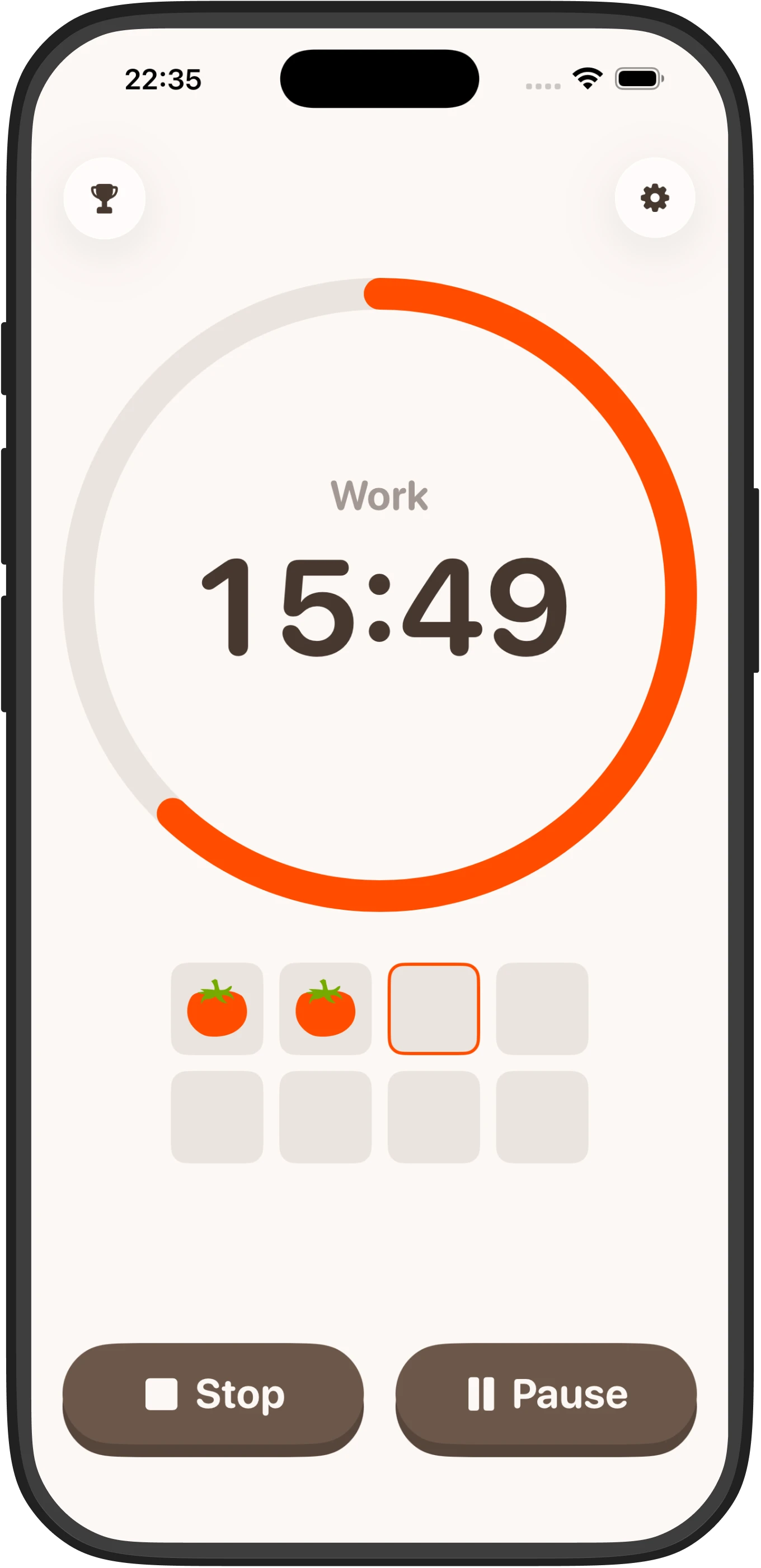
The Pomodoro Technique works on exactly this principle: 25-minute intervals with built-in breaks create a rhythm of mini-completions, each one a small, immediate payoff. For an ADHD brain that benefits from more frequent reward signals, those micro-rewards add up. If you’re looking for something that applies this without any setup friction, Pomo, a free iPhone timer, works offline with no account — you open it and start. That low barrier to entry matters more than it sounds when task initiation is already hard.
There’s also a broader point worth making here: timers work not just because of the intervals, but because they externalize the passage of time. They do the work your internal system finds harder. The neurobiological differences are still there, but you’re no longer relying on a less reliable internal system to navigate around them.
Immediate Rewards Beat Distant Consequences Every Time
One practical implication of how ADHD reward processing works: stop trying to motivate yourself with long-term consequences. “This will hurt my grade,” “my boss will notice,” “I’ll feel guilty later” — these are real consequences, but they’re temporally distant, and the ADHD reward system may underweight them.
What works instead is building immediate payoffs into the structure of the work itself:
- Set a 15-minute timer and give yourself permission to stop when it goes off
- Work in a location with social visibility — even a café, or a virtual co-working session — because social stakes are immediate (body doubling works on this principle, and it’s covered in depth in ADHD productivity methods compared)
- Pair a boring task with something that provides immediate engagement
FAQ
Is ADHD procrastination really about dopamine?
Yes, research including Volkow’s 2009 PET imaging study shows that people with ADHD have lower dopamine D2 receptor availability in the striatum, the brain region responsible for motivation and reward processing. This neurobiological difference makes it harder for the brain to register anticipated rewards, which is why procrastination in ADHD is not a character flaw but a neurobiology issue.
Why doesn’t willpower work for ADHD procrastination?
Willpower assumes the problem is motivational, but ADHD procrastination stems from reduced dopamine signaling that your conscious effort can’t override. You can’t will yourself to have optimal dopamine receptor function, which is why “just try harder” advice fails—it’s addressing the wrong problem.
How do timers help with ADHD procrastination?
Timers work as a dopamine workaround by creating concrete, immediate reward signals that the ADHD brain can detect better than abstract long-term goals. A 20-minute countdown makes the endpoint specific and achievable, whereas “finish this project” remains too distant and diffuse to trigger motivation.
Why do distant deadlines feel less real with ADHD?
People with ADHD experience temporal discounting, meaning distant rewards feel less valuable than immediate ones, combined with less reliable internal time perception. A deadline three weeks away barely registers as real because the brain doesn’t process it as concrete until it becomes imminent and creates emotional or sensory pressure.
What works better than distant consequences for ADHD motivation?
Immediate rewards and external structure work better than long-term consequences because the ADHD reward system underweights distant outcomes. Building in quick payoffs like 15-minute timer intervals, social visibility (body doubling), or pairing boring tasks with immediate engagement creates the frequent reward signals the ADHD brain needs to maintain focus.