

You sit down to work. An hour later, you’re still technically “working” — but you’re re-reading the same sentence, tabbing between windows, and wondering why nothing is getting done.
That’s not laziness. That’s biology. And the fix isn’t more discipline — it’s shorter sessions.
Here’s the science behind why working in short bursts consistently outperforms long, unbroken blocks, and what’s actually happening in your brain when you try to power through.
Your Attention Isn’t Infinite — It Has a Timer
Most of us were taught to treat focus like a skill you improve through willpower: sit longer, concentrate harder, resist distraction. But research from the last two decades tells a different story.
Psychologists Stephen and Rachel Kaplan developed Attention Restoration Theory (ART) in the late 1980s, proposing that directed attention — the kind you use for deliberate mental work — draws on a finite cognitive resource. Use it long enough without a break, and performance degrades. Rest it, and it recovers.
This wasn’t just theoretical. A 2008 study by Marc Berman and colleagues at the University of Michigan measured attentional capacity before and after rest periods. Brief mental breaks showed restorative effects compared to continuous work.
Then there’s Gloria Mark’s research at UC Irvine. Her work tracking office workers found that attention begins to measurably degrade after extended periods of continuous focused work — even in people without attention difficulties. After that point, you’re not just less productive; you’re working against your own cognitive state.
What Dopamine Has to Do With Deadlines
Here’s where it gets interesting. Short work sessions don’t just avoid the depletion problem — they actively trigger something that helps you start.
Time constraints engage your brain’s dopamine system in a specific way. A 2004 study by Dreisbach and Goschke showed that moderate time pressure increases dopamine activity in the prefrontal cortex, the region responsible for sustained attention and goal-directed behavior. That’s why a deadline — even a self-imposed one — can make a task feel more compelling than it did five minutes earlier.
This is partly why people with ADHD sometimes perform better under pressure. It’s not that the work becomes easier. It’s that the approaching boundary creates enough urgency to engage the dopamine pathways that ADHD brains struggle to activate on demand.
The key word is moderate. Dreisbach and Goschke’s research also found that extreme pressure collapses cognitive flexibility. Short, bounded sessions — not panicked sprints — hit the sweet spot where dopamine rises without the cortisol overwhelm.
Your Brain Has Biological Work Cycles You’re Probably Ignoring
In 1953, sleep researcher Nathaniel Kleitman — the scientist who co-discovered REM sleep — identified that the brain cycles through approximately 90-minute periods of higher and lower arousal during sleep. He later proposed that these ultradian rhythms extend into waking hours too, alternating between higher cognitive performance windows and natural recovery dips.
Whether you’re aware of it or not, your brain is cycling through these patterns all day. Fight them with willpower and you’ll notice the familiar symptoms: restlessness, difficulty concentrating, the urge to check your phone. Work with them and you’re structuring sessions around genuine biological peaks.
The practical implication: plan your most demanding work into 60–90 minute blocks max, with deliberate transitions built in. Not because you’re not motivated enough, but because that’s approximately the length of the window before the system needs to reset.
Even within that window, there’s a smaller-scale cycle worth knowing about.
The 20–30 Minute Alertness Window
Norepinephrine — the neurotransmitter most responsible for sustained alertness — doesn’t stay elevated continuously. Research on the locus coeruleus, the brain region that regulates norepinephrine release, shows that alertness operates in functional cycles, with natural troughs between peaks.
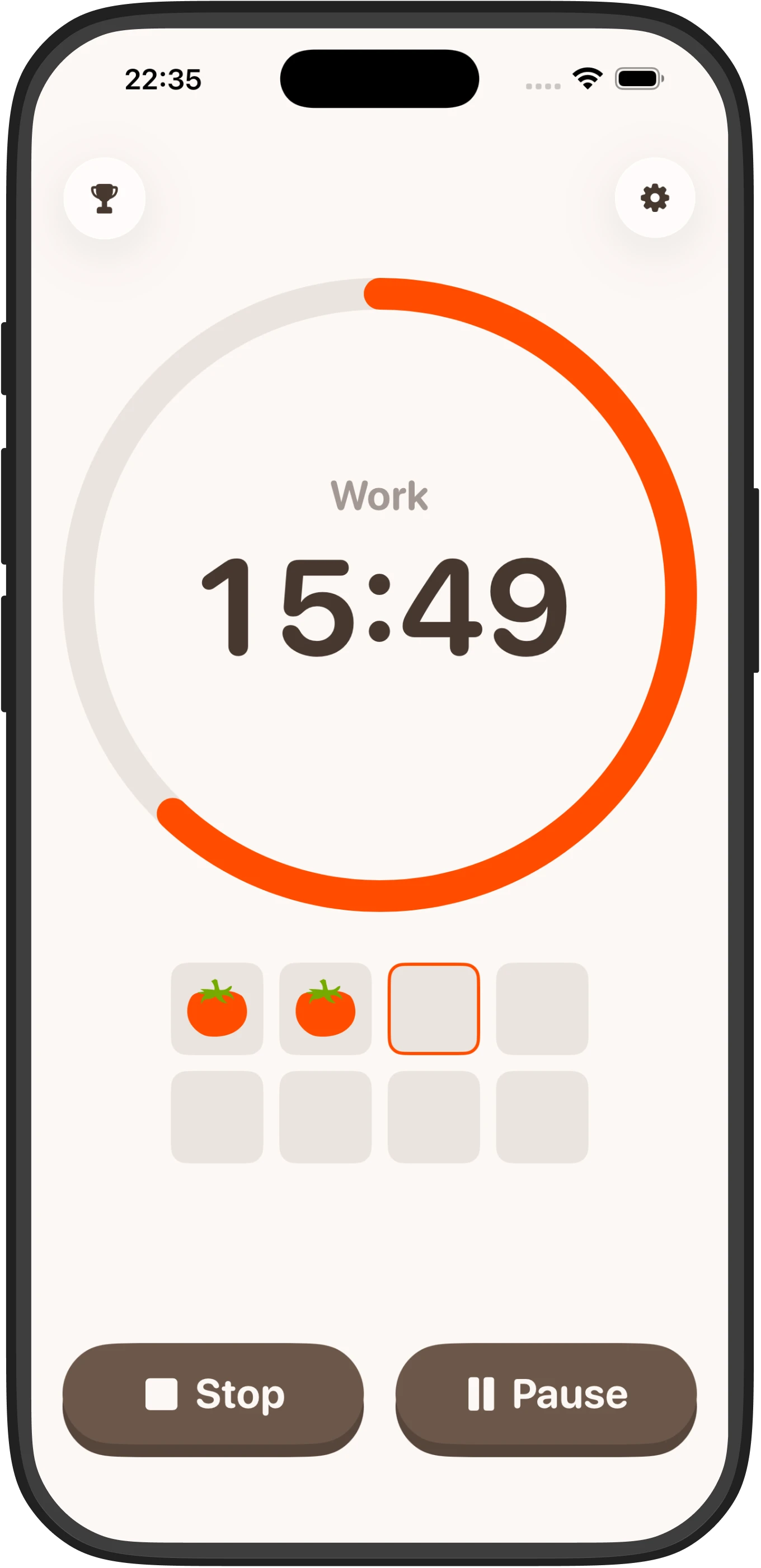
This is why 25-minute work intervals are commonly used. They’re roughly calibrated to natural neurochemical cycles — active enough to sustain focused work, short enough to stop before the system starts coasting downhill.
If you’ve used a Pomodoro-style timer and noticed that 25 minutes feels just right — not too rushed, not dragging — that’s probably why. The format is inadvertently aligned with your neurochemistry.
What the Productivity Data Shows
The neuroscience makes sense in theory, but what happens in practice?
Various time-tracking studies and productivity research have found that people who work in structured 25–30 minute sessions report higher task completion rates compared to those who work in unstructured blocks.
The deeper issue is that long unbroken work blocks create a specific trap. Research on continuous task engagement found that uninterrupted work without breaks progressively increases cognitive load, making it harder to filter out irrelevant information. You become more distractible the longer you push through — not less, as many people assume. Short sessions sidestep this entirely by building in regular cognitive reset points.
The Practical Translation: What Session Length Actually Fits What Work
Not all cognitive work is the same, and session length should reflect that.
For deep concentration work (writing, coding, analysis): 25 minutes on, 5 off. This keeps cognitive load from accumulating. After four sessions, take a longer 20–30 minute break to honor the ultradian rhythm.
For lighter tasks (email, admin, routine decisions): 15–20 minute blocks work well. These tasks deplete working memory less, so you can cycle through them faster.
For creative or generative work: Some people find that 45–50 minute sessions allow enough time for the ramp-up period and a genuine creative stretch before fatigue sets in. The key is the boundary — having a defined end point matters more than the exact number.
What doesn’t work is the vague “I’ll work until I’m done” approach. Without a time boundary, there’s no urgency signal to the dopamine system, no built-in reset point for directed attention, and no protection against the cognitive degradation that happens with extended unbroken work.
The Real Reason Long Work Sessions Feel Productive
There’s one more thing worth naming directly: sitting at a desk for three hours feels like working hard, even when actual output per hour has collapsed.
This is a measurement problem disguised as a motivation problem.
FAQ
How long should a work session actually be?
For deep work like writing or coding, aim for 25-minute sessions with 5-minute breaks. Lighter tasks work well in 15-20 minute blocks, while creative work may extend to 45-50 minutes. The key is having a defined boundary rather than a specific duration.
Why do I feel more productive working long hours if short sessions are better?
Long work sessions feel productive because you’re sitting at your desk for hours, but research shows actual output per hour declines significantly after 60-90 minutes of continuous work. You’re measuring time spent, not results achieved.
Is the Pomodoro technique based on science?
Yes. The 25-minute interval in Pomodoro timing is roughly aligned with natural norepinephrine cycles that regulate alertness in your brain. This is why 25 minutes tends to feel “just right” for most people without feeling rushed or dragging.
Can short work sessions help with ADHD?
Short sessions with defined time boundaries can help ADHD brains by creating moderate time pressure, which increases dopamine activity in the prefrontal cortex. This engages the attention pathways that ADHD brains struggle to activate without external structure.
What’s the difference between attention depletion and attention cycles?
Attention depletion is the gradual decline in focus during continuous work due to finite cognitive resources. Attention cycles are the brain’s natural 90-minute ultradian rhythms of higher and lower arousal throughout the day, which you should structure work around rather than fight.