

You tried Pomodoro. You set the timer for 25 minutes, worked until it went off, and then… something went wrong. Maybe the alarm interrupted you right when you finally got into the work. Maybe the 5-minute break stretched into 45. Maybe you spent half the session watching the timer instead of thinking.
If that sounds familiar, you’re not doing it wrong. The standard Pomodoro format has some genuine design flaws that hit ADHD brains especially hard. This article breaks down exactly what those flaws are — with the research to back it up — and what to do instead.
The Promise vs. the Reality
The Pomodoro Technique was designed by Francesco Cirillo in the late 1980s as a way to beat procrastination through short, committed work intervals. The core idea is sound: time-box your attention, take regular breaks, repeat.
For a lot of people, it works reasonably well. For ADHD brains, the standard implementation often creates more friction than it removes.
Mistake #1: The Timer Interrupts Hyperfocus at the Worst Moment
One of ADHD’s paradoxes is hyperfocus — the ability to lock in so completely that hours vanish. When it happens on something productive, it’s remarkable. And it’s exactly what Pomodoro destroys.
Research on flow states shows that forced interruptions during deep cognitive engagement can disrupt focus and require time to recover. Interruptions during engaged work can take significant time to recover from.
For ADHD brains, re-entry is even harder. Executive dysfunction means that restarting a complex task isn’t just a matter of picking up where you left off — the whole mental scaffolding has to be rebuilt. So if the timer goes off when you’ve finally hit your stride, you don’t just lose 5 minutes. You might lose the rest of the session.
The fix: Give yourself permission to override the alarm when you’re genuinely in flow. Use the timer as a minimum commitment, not a ceiling. Set it for 25 minutes, but if you’re locked in when it goes off, keep going. The timer’s job is to get you started, not to stop you.
Mistake #2: You’re Watching the Timer Instead of Working
This one is subtle but worth naming. When the timer is visible and counting down, it becomes an object of attention — and attention in ADHD is already a scarce resource.
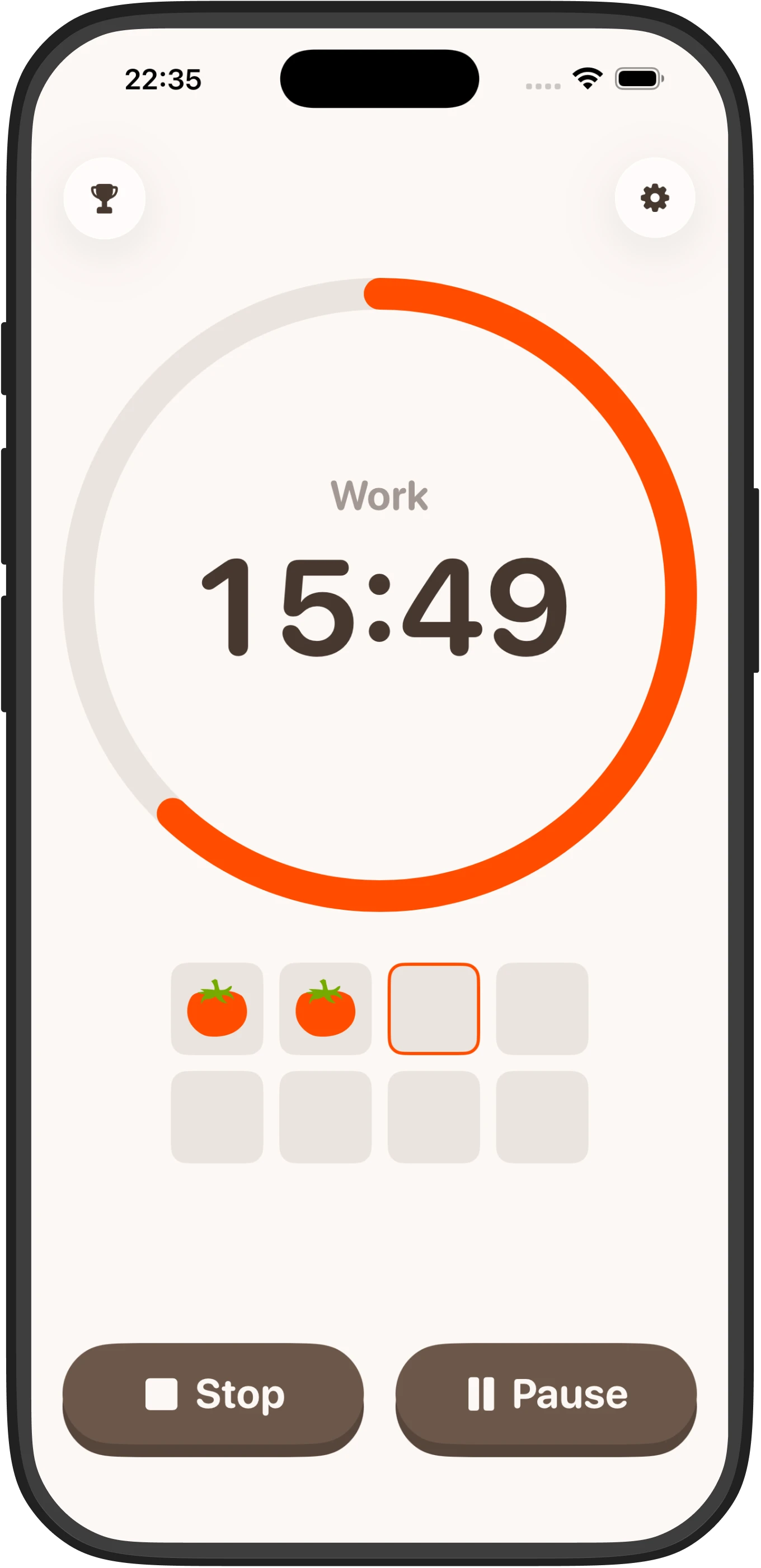
Research on time perception and attention in ADHD suggests that overly visible time structures can compete for cognitive resources. Constantly glancing at a countdown doesn’t create urgency — it creates low-level anxiety that competes with your task for attention.
The fix: Put the timer somewhere you can’t see it. The sound of the alarm matters; the countdown number doesn’t. If you’re using an app, flip your phone face-down. Run timers in the background without a visible countdown if possible — a small design choice that matters more than it sounds when you’re trying to actually focus.
Mistake #3: The 25-Minute Interval Is Arbitrary
Cirillo chose 25 minutes because his kitchen timer happened to be that size. There’s no research establishing 25 minutes as an optimal cognitive interval — and for ADHD, the mismatch can be significant in either direction.
For some people with ADHD, 25 minutes is way too long. Attention drifts after 10–12 minutes, and the remaining time becomes a slow drift into distraction. For others — especially those prone to hyperfocus — 25 minutes is too short to do anything meaningful before the alarm destroys the momentum.
Research on ADHD and time perception indicates that ADHD brains experience time in a distorted way, meaning 25 minutes can feel very different depending on the day, the task, and your current state.
The fix: Treat the interval as a variable, not a rule. Start a new task with a shorter sprint — 12 or 15 minutes — just to build momentum. For familiar, lower-demand work, stretch to 35 or 40 minutes if that matches your actual attention curve. The goal is to find the interval that creates gentle pressure without anxiety.
Mistake #4: The Breaks Don’t Actually Restore Attention
The 5-minute break sounds like a reset. In practice, most people spend it scrolling their phone — and then wonder why they can’t refocus.
Research on attention restoration indicates that genuine cognitive recovery requires “effortless attention” — environments or activities that engage without requiring directed focus. Scrolling social media is not that. It’s attentionally demanding in a passive-looking way, and it doesn’t restore anything.
For ADHD specifically, the type of break matters even more. Dopamine-spike activities (checking likes, fast-paced video) can make it harder to return to slow, demanding cognitive work afterward.
The fix: Design your breaks intentionally. Get up and move — even two minutes of walking produces measurable improvements in executive function. Look out a window. Do a breathing exercise. Make a cup of tea. The key is choosing something genuinely low-stimulation that your brain can coast through, not something that fires up the reward system.
Mistake #5: You’re Switching Tasks Between Pomodoros
This is the sneakiest Pomodoro failure mode. You finish a session on Project A, take a break, and decide to start Project B because you “need variety.” Repeat twice more. By the end of the afternoon, you’ve done four Pomodoros on four different tasks and made real progress on none of them.
Research on task switching shows that switching between tasks incurs significant cognitive costs — and the effects are amplified in ADHD populations because executive dysfunction makes mental shifting slower and more effortful.
The Pomodoro structure, with its natural “break” between sessions, creates a built-in temptation to switch. And ADHD brains, which are novelty-seeking by nature, are especially vulnerable to this.
The fix: Decide on your task before starting the timer — and commit to it for at least two consecutive sessions. Write it down. The act of writing creates a mild implementation intention, which can significantly increase follow-through.
FAQ
Why doesn’t the Pomodoro Technique work for ADHD?
The standard Pomodoro format has design flaws that particularly affect ADHD brains: it interrupts hyperfocus at critical moments, creates low-level anxiety through visible timers, uses an arbitrary 25-minute interval that doesn’t match ADHD attention spans, provides ineffective breaks, and encourages task-switching between sessions.
How long should Pomodoro intervals be for ADHD?
There’s no one-size-fits-all answer because ADHD brains experience time differently. Start with 12-15 minutes for new tasks to build momentum, or stretch to 35-40 minutes for familiar work if that matches your attention curve. The goal is finding the interval that creates gentle pressure without anxiety.
What’s the best type of break during Pomodoro sessions?
Breaks should involve genuine “effortless attention” activities like walking, looking out a window, deep breathing, or making tea. Avoid dopamine-spike activities like checking social media, which fire up the reward system and make it harder to return to focused work.
Should you stop working when the Pomodoro timer goes off if you’re in flow?
No. Use the timer as a minimum commitment, not a ceiling. If you’re genuinely locked in and making progress, override the alarm and keep going. The timer’s purpose is to get you started, not to interrupt your momentum.
How do you stop task-switching in Pomodoro sessions?
Decide on your task before starting the timer and commit to at least two consecutive sessions on the same project. Write down what you’re working on—this simple act of writing creates an implementation intention that significantly increases follow-through and prevents distraction-driven switching.