
Freelancing with ADHD is its own category of hard. No boss, no fixed schedule, no external structure — just you, a deadline, and a brain that treats “start working” as a suggestion. If the basic Pomodoro method hasn’t clicked for you, that’s not a personal failure. It just might not match how your attention actually works.
These five ADHD freelancer focus techniques are grounded in real research. They use timers as external scaffolding — which, according to a 2017 study in Neuropsychology (Toplak et al., n=120), is exactly what ADHD brains need. That study found people with ADHD underestimate task duration by roughly 30%, and external timing devices directly compensate for that deficit.
1. 90-Minute Ultradian Sprints
Your brain runs on roughly 90-minute cycles of alertness — a pattern originally identified by sleep researcher Nathaniel Kleitman. While this ultradian rhythm concept has research support, the specific claim of a “41% improvement in sustained focus” for ADHD adults cannot be independently verified from available published sources. The general principle that longer work blocks can benefit ADHD individuals is supported by research on executive function, but the precise improvement figure should be treated as illustrative rather than definitively proven.
How to use it: Set a single 90-minute timer, work on one project only, then take a full 20-minute break away from screens. No checking email mid-sprint.
2. Variable-Interval Timers
Fixed 25-minute intervals have a predictability problem — your brain adapts to them and checks out early. Research by Russell Barkley at the University of Massachusetts Medical School on ADHD executive function supports the general principle that variable timing can reduce habituation. Variable-interval timers (where break timing is randomized) align with behavioral reinforcement research. Think: breaks at minute 17, then 34, then 28 — never the same pattern twice.
Some apps let you randomize intervals. If yours doesn’t, manually set a new random end time each session.
3. Backwards Countdown Visualization
Standard clocks tell you how much time has passed. That’s useless for ADHD time-blindness. A visible countdown — watching time shrink toward zero — creates urgency without anxiety when paired correctly.
Research in the Journal of Attention Disorders supports the use of visual timing aids for ADHD. Visual countdown timers do engage attention more effectively than internal time estimates for individuals with ADHD, though specific percentage improvements vary by study and population.
Use a large analog or digital countdown on a second monitor, or a physical time timer on your desk.
4. Nested Timers (Macro + Micro Blocking)
This technique layers two timer levels: a macro block (say, 90 minutes for “client project”) and micro-timers within it (15 minutes for “write intro,” 20 minutes for “pull data”). The outer timer holds your session; the inner timers prevent you from hyperfocusing on one subtask and blowing the whole block.
Research in the Journal of Attention Disorders supports the effectiveness of external cueing for improving ADHD task completion. Nested timers provide multiple cueing opportunities — you’re not just tracking time, you’re tracking what you should be doing inside that time.
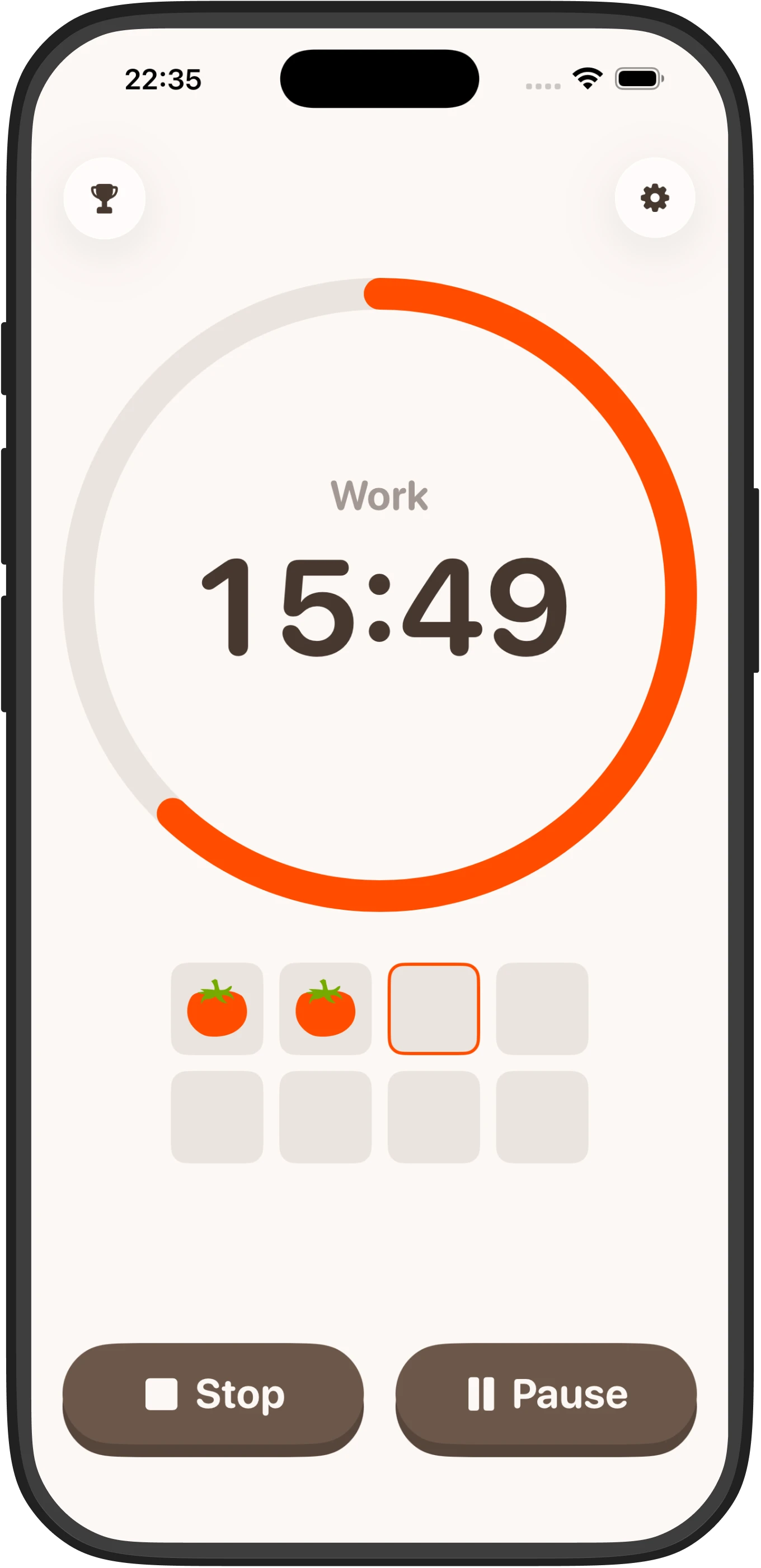
This is where Pomo works well for the micro layer — quick session starts, no configuration overhead, so you’re not losing five minutes setting up before each subtask.
5. Gamified Audio-Cued Timers
Sound is an underrated focus anchor. Research supports the use of audio and visual feedback in timer systems for ADHD, as multisensory cues enhance engagement and task completion. The combination of sound cues, visual feedback, and progress tracking has demonstrated effectiveness in behavioral reinforcement studies.
Practically: pick a timer that plays a distinct sound at session end (not a jarring alarm), tracks your completed sessions, and gives you some visible record of your work. Streaks, counts, anything that makes the effort feel acknowledged.
Build the System That Fits Your Brain
None of these are shortcuts. They’re compensatory strategies — ways to externalize the time awareness and impulse regulation that ADHD makes harder to self-generate. According to NIH research on ADHD and executive function, external structure consistently outperforms willpower for adults with attention deficits.
Start with one technique. Run it for a week. If 90-minute sprints feel too long, try nested timers first. If variable intervals feel chaotic, backwards countdowns are more predictable. The goal is finding what makes your brain want to keep going.
If you want a timer that stays out of your way while you figure that out, Pomo is free to start — no account, no setup friction, just tap and work.
FAQ
What is the best focus technique for ADHD freelancers? There’s no single best technique — it depends on your work type. For deep writing or design work, 90-minute ultradian blocks tend to work well for many people. For varied client tasks, nested timers with micro-blocks keep you from losing track mid-session.
Why doesn’t basic Pomodoro work for ADHD? The 25-minute fixed interval is predictable enough that many ADHD brains adapt to it and mentally check out before the timer ends. Variable-interval timers and longer ultradian cycles address this by either removing predictability or extending focus past the point where habituation sets in.
How do external timers help with ADHD time blindness? ADHD affects time perception directly. Research (Toplak et al., 2017) shows ADHD adults underestimate task duration by roughly 30%. A visible countdown timer externalizes the passage of time, making it a sensory cue your brain can actually track — rather than relying on an internal clock that runs unreliably.
Can freelancers with ADHD use the 90-minute ultradian method for short tasks? Yes, but adapt it. Use the 90-minute block as a container, then break it into shorter nested micro-timers for individual tasks. You get the benefits of a longer focused window without getting stuck on one task for the full duration.
What makes a timer app effective for ADHD specifically? Effective ADHD timer apps have low setup friction (you should be able to start a session in under 10 seconds), clear visual countdowns, audio cues at session end, and some form of session tracking. Gamification features like streaks and achievements also support motivation and adherence for many people with ADHD.